








Twenty-five billion dollars is an extraordinary amount of financing. Proposition 37 would authorize the California Housing Finance Agency to raise as much as that amount from investors and lend the proceeds to eligible purchasers of qualifying new homes. A family could combine a conventional first mortgage, a second mortgage covering up to 17 percent of the purchase price, and a buyer contribution of at least 3 percent. That arrangement reduces the initial cash a purchaser must bring to the transaction. It does not reduce the price of the home. It creates another loan that has to be financed and repaid.¹
The question for California is whether $25 billion is supported by an economic and financial plan capable of turning borrowed investor capital into sustainable ownership and additional homes. The program begins with private investors, passes through a state housing finance agency and ends with household mortgage obligations. The success of each stage depends on the stage before it.
What Does a $25 Billion Bond Authorization Mean?
The word “bond” sounds like a promise backed by the state, but different bonds have different repayment structures. Proposition 37 authorizes revenue bonds. Investors would advance money to the California Housing Finance Agency (CalHFA), and payments on the homebuyers’ second mortgages would be intended to repay the investors and cover program administration. The Legislative Analyst’s Office concludes that the measure would create no direct state or local costs. That conclusion reflects the proposed payment structure, rather than a guarantee that every mortgage will perform as expected.²
The $25 billion figure is a maximum authorization. It is not $25 billion already sitting in an account. CalHFA would decide how many bonds to issue and when. It could issue less than the authorized amount. If investors do not purchase the bonds on workable terms, the amount reaching prospective homebuyers would be smaller. A borrower cannot receive assistance from investor capital that has not been raised.
The distinction also matters to taxpayers. Revenue bonds are designed to be repaid from specified program revenues rather than general tax collections. The legal obligations of the issuer and the revenue pledged to investors determine the protection each investor receives. The official fiscal analysis states that the program is expected to impose no direct government costs. That is different from saying the investment carries no financial risk. Borrowers, bondholders and the administrator still face the possibility of late payments, defaults, changing interest rates and administrative costs.
Where the Money Would Come From
Consider an investor buying a $100,000 bond issued to finance part of this program. The investor gives the issuer $100,000 today in exchange for a promise of scheduled principal and interest payments on stated terms. CalHFA puts the net proceeds to work through eligible mortgage loans. Homebuyers make payments on the second mortgages. Those collections support the financing obligations and the costs of running the program.
The full issuance proceeds are not necessarily available dollar for dollar to make loans. Under a particular bond transaction, money may be required for issuance expenses, reserves, servicing and other legally permitted uses. The precise amounts must come from the actual offering and program documents. The amount of debt authorized, the amount issued, the amount investors buy and the amount loaned to purchasers are separate financial quantities.
This is why $25 billion does not automatically represent $25 billion in completed housing purchases. It represents a ceiling on one source of capital for a particular portion of a home purchase.
Who Would Buy the Bonds?
A bond buyer gives up use of money today for a future stream of payments. The expected yield must be attractive enough for that investor, considering risk, tax treatment, maturity, liquidity and other available investments. Some investors may accept a lower return because the investment supports a social purpose. Others must meet investment mandates and financial-return targets.
The distinction becomes significant when the bonds support second mortgages. When a home is sold after a default and the sale proceeds are insufficient to pay every debt, the first mortgage generally has priority over the second. A subordinate loan may therefore lose money even if a first-mortgage investor is fully repaid. A portfolio of second mortgages also has repayment, prepayment, servicing and geographic risks. The required investor yield depends on how those risks are allocated and what protections are offered.
Proposition 37 directs CalHFA to seek broad investor participation and minimize borrowing costs. It does not establish a single investor yield in advance. The interest rate investors will accept must be determined in the market for the actual financing.
A 3 Percent Scenario Is Not a 3 Percent Commitment
The most favorable published economic case comes from a September 2026 report by Shane Phillips of Domain Consulting, prepared for the Yes on 37 campaign. It models full subscription by investors willing to accept a concessionary rate of approximately 3 percent. Under those assumptions, each $1 billion could support about 7,600 bond-financed new homes, or roughly 190,000 homes if the full $25 billion were placed and used as modeled.³
Those are consequential numbers. They also show why interest-rate assumptions are fundamental rather than incidental. The report acknowledges that it cannot predict whether the required investors will materialize. It includes a sensitivity scenario at 6 percent and reports that affordability eligibility would be lower than in its 3 percent scenario. A below-market investor return may improve the number of households able to afford the loans, but the lower return must be accepted by someone supplying capital.
For the family purchasing a home, the investor’s yield and the second mortgage’s interest rate are connected but not automatically identical. Servicing costs, administrative charges, transaction structure and loan performance affect how the two rates relate. CalHFA would set borrower rates and repayment terms consistent with the measure’s requirements. A 3 percent investor scenario cannot be presented as an approved 3 percent second mortgage for every homebuyer.
What a Second Mortgage Costs Each Month
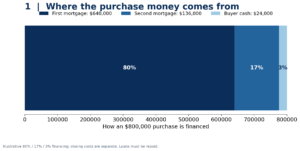
An $800,000 home illustrates the financing split. At the full 17 percent, the subordinate loan is $136,000. The conventional first mortgage covers $640,000, and the buyer contributes $24,000 toward the purchase. The second mortgage is not a grant. The buyer owes the lender that additional $136,000 under the terms established for the loan.
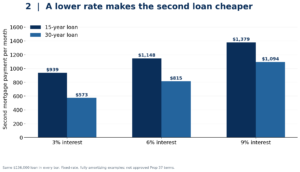
Monthly payments depend on the rate and term. A 3 percent second mortgage amortized over 15 years produces a materially different payment from a 6 percent or 9 percent loan of the same size. A longer term reduces the scheduled monthly payment but generally increases interest paid over the life of the loan if rates are held constant. A deferred loan can lower immediate cash flow requirements while leaving principal and accrued obligations to be paid later. The proposition does not promise every borrower a fixed 15-year term, a deferred payment or a 3 percent rate; those are alternative illustrations until actual program terms exist.
A lower cash down payment is useful when lack of initial savings is the obstacle. It may be a poor solution when the additional monthly debt is the obstacle. A homebuyer must pay both mortgages and the property’s recurring charges from the same household income.
How Many Homes Could $25 Billion Finance?
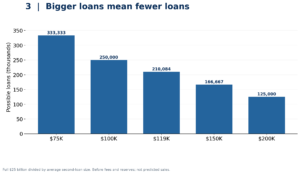
The simplest arithmetic divides the amount available for loans by the average subordinate-loan principal. With no deductions for expenses or reserves, $25 billion divided by a $100,000 second mortgage supports 250,000 loans. At $150,000 each, it supports about 166,667. At $200,000 each, it supports 125,000.
These are upper-bound illustrations of loan principal capacity, not estimates of eligible households, signed contracts or additional homes. Actual issuance expenses and reserves could leave less than the authorized amount available to lend. A borrower might also use less than the full 17 percent assistance, increasing the count of possible loans. Home prices and loan amounts will differ substantially among counties and housing types.
The $25 billion question therefore cannot be answered solely with a loan count. It requires an estimate of financing demand at specific borrower interest rates, borrower ability to carry the payments, the supply of qualifying homes and the share of those homes that would not have been built without the program.
Why the Size of the Authorization Matters
One billion dollars, five billion dollars and twenty-five billion dollars represent different levels of potential investment. They also imply different expectations for investor participation, homebuilding and program administration.
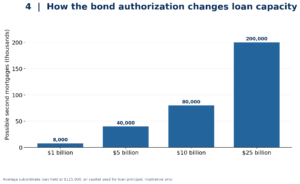
At a hypothetical average second loan of $125,000, $1 billion of principal capacity supports 8,000 loans; $5 billion supports 40,000; $10 billion supports 80,000; and $25 billion supports 200,000. The relationship is proportional because the calculation holds the average loan balance constant. It says nothing by itself about which amount is most appropriate.
The case for a $25 billion authorization would be strengthened by evidence showing an expected issuance schedule, indicative investor demand and yields, expected loan sizes, sufficient eligible homes and loan applicants, the likely participation of builders, and a credible operating budget. Without those elements, the numerical ceiling describes ambition more clearly than it describes projected financial performance.
The measure gives CalHFA flexibility rather than requiring all bonds to be issued at once. That discretion can prevent capital from being placed when investor terms or borrower demand are unfavorable. It also means the full authorized total should not be treated as a promised quantity of near-term assistance.
Who Bears the Risk?
The first source of repayment is the borrower’s scheduled loan payments. A household that loses income may fall behind on the first mortgage, the second mortgage or both. If the home must be sold during a period of falling prices, the sale proceeds may be insufficient to repay every creditor. The first mortgage ordinarily claims its secured proceeds before the second mortgage receives the remainder.
That distinction is one reason investors evaluate subordinate mortgages differently from first mortgages. The fact that a borrower has purchased a newly built home does not eliminate the possibility of future financial distress or changes in property value.
The official fiscal analysis says the proposal creates no direct state or local cost because borrower payments are intended to repay bondholders. The risk of loss remains a real economic issue for the financing parties. Whether any future political decision might provide additional support is a separate question from the legal financial structure voters are being asked to authorize.
Investors also face the risk that homeowners repay loans earlier than projected, requiring reinvestment at different yields. The issuer faces the operational challenge of collecting payments, accounting for reserves and expenses, responding to defaults and satisfying bond covenants. A homebuyer faces the more immediate risk of carrying an additional monthly obligation.
What Happens When Loans Are Repaid?
Every mortgage has a repayment schedule or conditions governing when payment becomes due. Borrowers may repay through monthly amortization, refinancing, sale of the property or other events depending on the actual loan documents. Bondholders receive payments according to the bond indenture, which may not have exactly the same timing as individual homeowners’ repayment schedules.
If mortgage payments are pledged to repay outstanding bonds, those revenues are not automatically free to finance new borrowers a second time. Any recycling of proceeds depends on the legal structure, remaining bond debt and program rules. It is important to distinguish cash returned by borrowers from funds available for another round of lending.
The economic life of the program could extend well beyond the first wave of loans. That makes servicing standards, borrower communication, delinquency management and public performance reporting important components of a credible financial plan.
Would More Assistance Produce More Homes?
The full-subscription campaign model estimates approximately 190,000 bond-supported purchases. Its larger projected economic benefits depend on the assumption that the homes financed represent construction that would not otherwise occur. If only some of those homes are genuinely additional, the incremental economic impacts fall proportionally. The report itself presents 100 percent additionality as a favorable assumption and explains sensitivity to lower additionality.³
There is a difference between funding a purchase in a new development and causing an additional home to be built. Developers assess land costs, approvals, financing, labor, materials and the number of buyers prepared to sign contracts. Buyer financing can improve demand, but it cannot by itself resolve every constraint on construction.
A homeowner purchasing with assistance may also be a family that would have bought the home without the program. That transaction can help the family preserve cash, which has real value, but the transaction does not necessarily add a homeowner to the statewide total. A renter purchasing for the first time may increase the number of owner households. A current homeowner moving into a newly built home may initiate a resale chain that eventually expands ownership, though the outcome depends on who purchases the vacated homes.
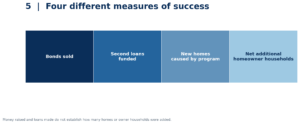
A serious performance report must distinguish loan recipients, newly completed eligible homes, homes constructed because of the program and net increases in homeowner households. Treating these four counts as equal would overstate what a financing authorization proves.
The Strongest Economic Case
The strongest argument for Proposition 37 is that it combines a widely recognized obstacle—large cash requirements at purchase—with financing restricted to qualifying newly built or newly converted housing. Some families can carry a mortgage but struggle to accumulate a very large down payment while paying rent. A second mortgage could accelerate ownership for those households when its interest rate and payment terms are manageable.
The program could also make lower-priced new homes more marketable to eligible buyers. The qualified-builder option changes certain construction-defect and labor-enforcement rules for participating builders, which supporters believe could encourage more condominium construction. Lower-priced condominiums could extend program access to households priced out of detached homes.
If investors provide capital on favorable terms, builders respond with truly additional homes, and families retain sufficient income and savings after purchase, the program can produce tangible benefits. Those are the financial conditions that connect the promised assistance to sustainable outcomes.
The Cost of Capital Must Fit the Cost of Housing
A capital market has two sides. An investor wants compensation for lending money, and a purchaser needs the loan payment to fit within a household budget. The same interest rate has a different meaning to each participant. A bond paying less than comparable alternatives may be attractive to a social-impact investor, but that decision must be voluntary and consistent with the investor’s own obligations. A second mortgage carrying a rate higher than a borrower expected may turn a promising purchase into an unaffordable one.
A large authorization cannot change that fundamental arithmetic. Assume the same home and borrower. When the second mortgage carries a 3 percent rate rather than a 9 percent rate, monthly payment savings may be substantial, particularly on a 15-year term. But a lower rate on the smaller second loan does not erase the cost of the larger first loan, property taxes, insurance or community assessments. Those costs remain tied to the property and financing structure. Interest concessions can improve affordability; they are not a substitute for an affordable purchase price.
The investor has a parallel problem. A second mortgage is a claim on a home behind a first mortgage. At origination, a home may be worth more than the two debts combined. If prices fall, the equity protecting the junior investor shrinks first. An $800,000 home purchased with the maximum illustrated 80/17/3 structure carries $776,000 in combined mortgage principal at closing. That leaves only $24,000 in initial buyer equity, or 3 percent of the purchase price, before considering selling expenses and changes in the loans’ balances. This does not mean the borrower will default or that the loan lacks value. It means the initial equity cushion is small.
Suppose that same home’s value declined to $720,000 immediately after purchase and that neither mortgage balance had yet changed. The first lender’s $640,000 principal would leave $80,000 of gross value before selling expenses for the $136,000 second mortgage. The second loan would have a potential $56,000 principal shortfall under that simplified liquidation illustration. Selling and foreclosure expenses could further reduce the available proceeds. These figures illustrate lien priority, not a forecast of California house prices or investment losses.
The effect in the opposite direction also matters. If values rise and principal balances fall, a borrower may build equity and increase the financial protection available to both lenders. The credit profile of the portfolio over time, not one hypothetical house, determines the bond program’s aggregate performance. It is therefore essential to understand the pool’s diversification, borrower debt levels, loan terms, reserves and collection procedures.
Investor Yield Versus Borrower Interest
Bond investors may buy securities priced at a discount or premium to their face amount. Some bonds amortize over time; others have scheduled principal repayments or structural protections. The yield to the investor depends on the issue price and timing of cash flows, not simply the coupon printed on the security. Homebuyers, meanwhile, experience the cost through the interest rate, amortization, fees and required monthly payment of the loan they sign.
A borrower at a 3 percent fixed rate might reasonably see the program as a valuable source of affordable financing. But the same borrower at a higher rate must assess the complete monthly payment. The economic connection between the investor rate and borrower rate is shaped by costs and protections built into the financing. The bond marketing document and borrower loan terms will determine the actual relationship.
The distinction is particularly important when investors are asked to accept below-market returns. The campaign-sponsored report relies on favorable concessionary investment assumptions in its central illustration. A credible public explanation should make the source of that concession clear: investors accept a lower return in exchange for a social objective. There is nothing inherently improper about that arrangement. Its scale, duration and availability determine whether it can support the quantity of loans envisioned.
A $25 billion program funded entirely on favorable terms would perform differently from a program attracting only several billion dollars at those terms. The issue is not the sincerity of an investor’s intentions. The issue is the amount of legally committed and financially available capital.
Borrower Protection Must Extend Beyond Closing
A family’s financial obligation continues long after the keys are delivered. Mortgage servicing determines how borrowers receive statements, make payments, resolve errors and obtain assistance after a temporary setback. Clear disclosures must explain the priority of each loan, the date payments begin, the amount due, what happens after delinquency, and the consequences of refinancing or selling.
When a buyer signs a first mortgage and a second mortgage at the same closing, each creditor has its own contractual rights. The borrower does not have one combined obligation merely because the financing was presented as one homeownership program. A lower initial down payment changes the arrangement of debt and equity; it does not remove the responsibility to repay.
The consumer’s relevant figure is the entire monthly cost of maintaining the home. That includes the loans and recurring property charges, along with a realistic allowance for repairs and ordinary household expenses. The state can create a financing mechanism, but the borrower must maintain the property and remain current on the payments.
A Program That Can Be Measured
The financing should be evaluated in stages. First comes the amount of bonds sold and the terms investors accept. Second comes the amount of proceeds available for lending after required financing expenses and reserves. Third comes the number and size of mortgages actually originated. Fourth comes the number of qualified homes sold and the extent to which the program changes what builders construct. Fifth comes durable ownership: how many households became owners who otherwise would have remained renters, and how many are able to sustain ownership.
Each stage answers a different question. If bonds sell but few mortgages close, the financial market has not translated into the intended household benefit. If mortgages close on homes that would have been sold anyway, buyers may benefit from the financing without the full increase in housing production envisioned by supporters. If construction increases but payments leave families financially vulnerable, a higher housing-unit count would not fully capture the program’s performance.
Regular public reporting could show the amount of bonds outstanding, average investor yield, average borrower rate, average subordinate loan principal, number of loans closed, delinquencies and repayment performance. Reporting also should identify the mix of properties and counties served. Measures of actual additional construction and net new homeowner households require careful comparisons with a credible no-program baseline, not an assumption that every supported purchase produces an additional home.
The Appropriate Scale Is the Scale That Works
California can authorize a $25 billion ceiling without issuing the entire amount immediately. The value of that flexibility becomes clear when investor demand, borrower payments and housing production are considered together. A measured issuance schedule can respond to genuine demand at workable financing terms. The number of homes built can then be compared with the volume of assistance rather than assumed from the authorization alone.
A financing program should be judged by the homes families can afford and keep, not by the largest number printed on the ballot. Twenty-five billion dollars could represent an ambitious source of capital, a multiyear capacity ceiling, or an amount that the market never fully uses. The actual outcome depends on investors, borrowers, builders and the prices of qualifying homes.
What Happened to California’s Earlier Housing Bonds?
California has asked voters to finance housing before. Proposition 46 in 2002 authorized $2.1 billion in general obligation bonds for housing and emergency shelter. Proposition 1C in 2006 authorized another $2.85 billion. Proposition 1 in 2018 approved $4 billion for affordable housing and veterans programs, including $1 billion for veterans’ home loans. Proposition 2, also approved in 2018, authorized up to $2 billion in revenue bonds for supportive housing under the No Place Like Home program. The 2024 Proposition 1 authorized approximately $6.38 billion for behavioral health facilities and supportive housing, with approximately $2 billion designated for housing. Together, those five measures authorized approximately $17.33 billion across different purposes and financing structures.¹
Authorization is not issuance, and issuance is not expenditure. A bond approved by voters may be sold over a period of years. An appropriation may be awarded to a developer before construction begins, and a completed housing project may serve renters or people experiencing homelessness rather than new homeowners. The amount actually sold to investors, the amount disbursed, the homes produced and the amount of outstanding debt must therefore be examined separately.
What the State Auditor Found
California’s own audits expose serious failures in the oversight of earlier housing resources. A 2018 audit of programs financed by the 2002 and 2006 housing bonds examined eight programs representing approximately $3.4 billion. The Department of Housing and Community Development adequately monitored four and inadequately monitored four. Auditors also found that the department had not implemented half of the recommendations from earlier reviews. The problem was not merely delayed paperwork. The agency could not consistently demonstrate that required monitoring occurred and that the intended recipients were being served.²
A separate 2020 State Auditor investigation reached an even more consequential finding. The California Debt Limit Allocation Committee had mismanaged $2.7 billion in federal tax-exempt bond allocation authority that expired before it could be used. That authority could have helped finance affordable housing and unlock additional federal housing tax credits. It was not $2.7 billion in borrowed cash that vanished. It was a major housing-finance opportunity lost through poor administration, inadequate coordination and insufficient public disclosure.³
Those findings raise a direct question for a new $25 billion authorization: What administrative systems, reporting obligations and independent controls will prevent similar failures?
Where the Earlier Programs Stand
The five bond measures were approved in different years and support different types of housing. The 2002 and 2006 programs have long operating histories and multiple published audits. The 2018 measures are more recent and include both affordable rental production and specific homeownership programs. The 2024 authorization is still in implementation. Comparing them as though each promised the same outcome would conceal whether their original objectives were met.
For each measure, California should be able to see how much was authorized, how much was actually issued, how much was allocated and spent, how many units or households benefited, what remains outstanding and what auditors found. A program’s unit count also needs a clear definition. A supportive rental apartment, a rehabilitated property and an owner-occupied home are different results.
The Homeownership Test
The Census Bureau reports that 55.9 percent of occupied California homes were owner-occupied in the 2020–2024 period. That figure illustrates the continuing scale of the challenge. It does not, by itself, establish that earlier bond programs failed. Rental and supportive housing programs were designed to serve important needs other than raising the statewide homeownership rate. Their performance should be measured against those purposes.⁴
For programs explicitly intended to help households buy homes, a more exacting comparison is possible: how many eligible households purchased with assistance, how many would otherwise have remained renters, and how many sustained ownership? Those are the relevant outcomes for judging homeownership programs. The state’s overall ownership rate provides the long-term context; program records must explain what the financing actually accomplished.
A History California Can Use
The issue is not whether bond financing can ever help. It can. The issue is whether another authorization on an unprecedented scale will come with the operational capacity, investor commitments and public reporting needed to turn financial promises into documented results.
California’s history offers a practical standard. An authorization should be accompanied by reliable financial records, timely independent audits, transparent corrective action and measurable housing outcomes. Twenty-five billion dollars deserves a financing plan. It also deserves an accountability plan.
The Necessary Financial Test
The authorization’s effectiveness will be decided by the terms on which investors advance money, the homes builders deliver, and the payments households can afford. The amount on the ballot is only the beginning of that chain.
Twenty-five billion dollars is not the number of dollars required for every household to become a homeowner. It is a financing ceiling for a specific second-mortgage program. Nor is the total number of bond-funded mortgages equivalent to the number of additional homes or homeowners the program creates.
The defining questions are measurable: How much capital is actually raised? At what investor yield? At what borrower interest rate? How much reaches the homebuyer after financing and administrative costs? How many loans close? How many homes are newly built because of the financing? And how many additional households remain owners over time?
California’s housing challenge demands more than access to debt. The financing must help produce housing that people can purchase, afford and keep.
In the next chapter, the inquiry turns from the bond market to the wider economic consequences of directing new purchasing power toward California’s limited supply of homes.
Thank you for taking the time to read and reflect. I write to help people think clearly about money, business, real estate, and life, grounded in decades of lived experience and informed by research.
If you are navigating a financial decision, building a business, considering homeownership, or simply trying to make better use of your time and resources, I invite you to engage further.
Subscribe to The Power Is Now TV to connect with me live every weekday, Monday through Friday, from 10:00 AM to 11:00 AM PST, as we record television shows across the Power Is Now TV Network. As a subscriber, you can participate in live tapings, engage in real-time discussions, and connect directly with industry leaders.
Visit ThePowerIsNow.com to access real estate magazines, books, podcasts, television shows, and exclusive media content focused on homeownership, business, and wealth-building.
For personalized support, consulting, and advisory services in real estate, mortgages, business, and personal finance, visit EricFrazier.com to schedule a consultation and learn more about my work as your trusted advisor in business and wealth.
Eric Lawrence Frazier, MBA
Your Trusted Advisor in Business and Wealth
Real Estate Broker CA DRE 01143484 | Mortgage Originator NMLS 461807
ThePowerIsNow.com|EricFrazier.com